
Gel Electrophoresis Reagents and Buffers



Gold Biotechnology Inc GelRedTM Nucl Acid Gel Stain
GelRed is an ultra-sensitive extremely stable and environmentally safe fluorescent nucleic acid dye designed to replace the highly toxic ethidium bromide (EtBr) for staining dsDNA ssDNA or RNA in agarose gels or polyacrylamide gels GelRed is far more sensitive than EtBr without requiring a destaining step GelRed and EtBr have virtually the same spectra so you can directly replace EtBr with GelRed without changing your existing imaging system

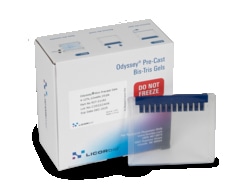
LICOR Odyssey, Bis-Tris, 10x8, 4-20%, 12 wells (pack of 10)
Odyssey Mini Gels are polyacrylamide gels designed to separate a wide range of protein sizes via PAGE or SDS-PAGE. Each box contains 10 pre-cast gels. Our gels feature larger well volumes for easier sample loading and are cast in a neutral pH buffer to increase gel stability. They also run at neutral pH, which minimizes protein modification compared to Tris-glycine gels. Odyssey Mini Gels are available in several gradients with 10, 12, or 15 numbered wells. Our gels feature a shelf life of up to 6 months at room temperature and 12 months at 2–8C.
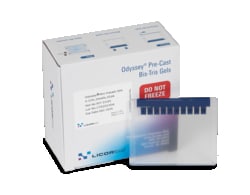
LICOR Odyssey, Bis-Tris, 10x8, 12%, 10 wells (pack of 10)
Odyssey Mini Gels are polyacrylamide gels designed to separate a wide range of protein sizes via PAGE or SDS-PAGE. Each box contains 10 pre-cast gels. Our gels feature larger well volumes for easier sample loading and are cast in a neutral pH buffer to increase gel stability. They also run at neutral pH, which minimizes protein modification compared to Tris-glycine gels. Odyssey Mini Gels are available in several gradients with 10, 12, or 15 numbered wells. Our gels feature a shelf life of up to 6 months at room temperature and 12 months at 2–8C.
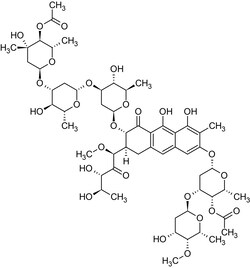
Abcam Chromomycin A3, fluorescent DNA stain, 5MG
MW 1183.2 Da, Purity >98%. Anthraquinone antibiotic, fluorescent DNA stain. Binds transcription factors Sp1 and SP3 to DNA to inhibit RNA synthesis. Shows anti-bacterial, anti-fungal and antitumor activities. Active in vivo.
The product is subject to the following: Abcam Restricted Use Statement
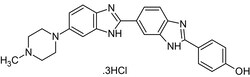
Abcam Bisbenzimide H 33258 (Hoechst 33258), adenine-thymine selective DNA fluorescent stain, 25MG
MW 533.9 Da, Purity >98%. Cell-permeable, adenine-thymine selective DNA fluorescent stain. DNA minor groove-directed agent. Labels DNA, chromosomes and nuclei. Stimulates topoisomerase I-mediated DNA cleavage. Bisbenzimide H 33342 (ab145596) analog.
The product is subject to the following: Abcam Restricted Use Statement
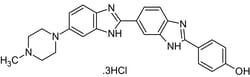
Abcam Bisbenzimide H 33258 (Hoechst 33258), adenine-thymine selective DNA fluorescent stain, 100MG
MW 533.9 Da, Purity >98%. Cell-permeable, adenine-thymine selective DNA fluorescent stain. DNA minor groove-directed agent. Labels DNA, chromosomes and nuclei. Stimulates topoisomerase I-mediated DNA cleavage. Bisbenzimide H 33342 (ab145596) analog.
The product is subject to the following: Abcam Restricted Use Statement
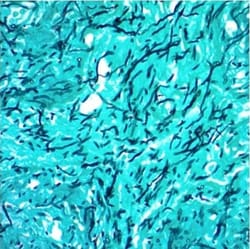
Abcam GMS Stain Kit.
GMS Stain Kit.
The product is subject to the following: Abcam Restricted Use Statement
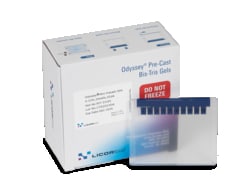
LICOR Odyssey, Bis-Tris, 10x8, 8%, 10 wells (pack of 10)
Odyssey Mini Gels are polyacrylamide gels designed to separate a wide range of protein sizes via PAGE or SDS-PAGE. Each box contains 10 pre-cast gels. Our gels feature larger well volumes for easier sample loading and are cast in a neutral pH buffer to increase gel stability. They also run at neutral pH, which minimizes protein modification compared to Tris-glycine gels. Odyssey Mini Gels are available in several gradients with 10, 12, or 15 numbered wells. Our gels feature a shelf life of up to 6 months at room temperature and 12 months at 2–8C.
Sigma Aldrich Fine Chemicals Biosciences Papanicolaou Stain EA 501L
PAPANICOLAOU Papanicolaou Stain EA 501L

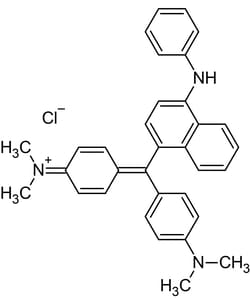
Abcam Victoria blue B, Nuclear stain, 25G
MW 506.1 g/mol. Used as a nuclear stain in cytology/histochemical applications. Can be used in the quantitative determination of phospholipids.
The product is subject to the following: Abcam Restricted Use Statement
Genscript Corporation PAGE-MASTER Protein Standard P
PAGE-MASTER Protein Standard Plus is a special-designed protein standard by Genscript The standard consists of nine proteins with molecular weight of 10kDa 15KD 20kDa 30kDa 40kDa 50KDa 60kDa 80kDa and 120kDa The proteins of 15 KDa and 50KDa are pre-stained proteins coupled with blue dye for easy visualization All the bands were highly purified thus gives excellent performance in SDS-PAGE gels
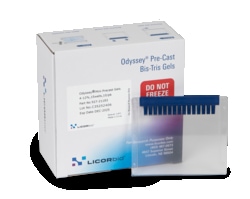
LICOR Odyssey, Bis-Tris, 10x8, 4-12%, 15 wells (pack of 10)
Odyssey Mini Gels are polyacrylamide gels designed to separate a wide range of protein sizes via PAGE or SDS-PAGE. Each box contains 10 pre-cast gels. Our gels feature larger well volumes for easier sample loading and are cast in a neutral pH buffer to increase gel stability. They also run at neutral pH, which minimizes protein modification compared to Tris-glycine gels. Odyssey Mini Gels are available in several gradients with 10, 12, or 15 numbered wells. Our gels feature a shelf life of up to 6 months at room temperature and 12 months at 2–8C.